Hi there! Duolit is on hiatus, but please feel free to explore our extensive archive of posts and our free Weekend Book Marketing Makeover. Thanks for visiting!

The Shocking Truth About Target Markets (They’re Not All That) [Lesson 3]

[printvers]

I like to ask the question Why?

Not entirely unlike a curious three year-old, I’m forever pestering people with my favorite follow-up inquiry in all types of situations.

  • Why?
  • Why did you do that?
  • Why should I listen to this?
  • Why is that the way it’s supposed to be?

I ask the question because I don’t just want to know something, I want to understand it.

In that vein, I think it’s important that before I share with you the shocking truth about target markets (which I pinky promise that I will do before the end of this post!), I need to explain why it is that we need them in the first place.

Reason #1: Our readers are stuck under the Niagara Falls of media blitzes every day.

Back in the Mad Men days of the 1950’s and 60’s, businesses had only three mediums to choose from when deciding how to advertise to their customers.

Radio, TV and newspapers were the only means of communicating with the masses and there were relatively few of each.

With a decent budget, a company could flood the market and reach at least 2/3 of the American population with a handful of well placed commercials.

Because there were so few forms of media, promoters didn’t have to worry so much about the right medium for reaching their target market.

It was  the equivalent of simultaneously firing a thousand arrows at one target—you were just statistically bound to hit the bullseye.

Flash forward to 2012 and most of us have televisions with over 100 channels (mine has 894). Almost all of those channels show programming 24/7, from informercials to realty shows and everything in between.

Those TV shows compete for our attention with the internet (on our computers), the internet (on our mobile devices), the internet (on our gaming systems) and any magazines or newspapers that might have somehow found their way into our house.

When we go outside, things get amplified. We are inundated with billboards, mass transportation ads, ads in store windows, political signs on the roadway and even those unfortunate souls paid to dance around with signs on the corner in the summer heat. Someone is always trying to sell us something.

Our readers all face the same deluge of promotions every day.

It would take us millions of dollars to break through that downpour of information to reach a significant portion of the population and last I checked, none of us are slogging through the self-publishing process with a million dollar budget.

Worse, even if we did have a huge budget to spend on a media blitz, we would be lucky if even an eighth of the people we reached were actually converted into new readers.

Hence, the reason we need a specific focus to our marketing campaigns so we can find the most efficient and effective means to locate and engage with the readers who will appreciate us and our novels.

Speaking of the perfect population of readers…

Reason #2: Careers are made by fans, not readers.

J.K. Rowling, Stephanie Myer, Stephen King, Nicholas Sparks, John Irving and Nora Roberts have successful writing careers because they have fans, not because they have readers.

What’s the difference?

Allow me to show you Exhibit A:
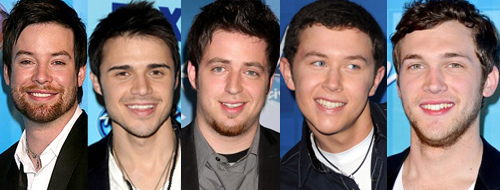
These are the last five winners of American Idol (David Cook, Kris Allen, Lee Dewyze, Scotty McCreery and Phillip Phillips).

Um…..Am I the only one who sees a pattern?

Now, I’m sure each of these young fellas has some talent…but the real reason why five adorkably cute, dark-haired white dudes have won America’s karaoke crown is because the show’s biggest fans are boy-crazy teenage girls.

These shrieking, crying, sign-making, braces-wearing gaggle of ‘tweens are the ones who text, call and vote online for their faves every week. They’re also the ones who buy the show’s singles on iTunes after every show, line up to get tickets to the concerts and spend a week’s allowance on the winner’s new album when it finally hits stores.

Of course, other people still watch American Idol, too.

My parents tune in on a regular basis and have been known to occasionally vote (even in the face of my dramatic eye-rolling at participating in such a silly event). But to the show, viewers like my parents are just icing on their billion dollar cake.

It’s the teenagers who have made that show a cash cow success story, and American Idol demonstrates their appreciation by catering to those rabid fans with their guest appearances, commercials, branding and format.

Finding your rabid fans and catering your writing to them is what will give you a successful author career as well.

That’s why we need to have a serious meeting about target markets.

Once upon a time, we were harping on you guys about the importance of having a target market. We even gave you a handy inverted pyramid to help you find the bullseye and discover success.

But we discovered that even with the six pieces of demographic data (country, setting, age, gender, education and class) generated in our target market exercise, it was still a struggle to get a clear picture of your fanbase.

So now we need to build on your target market, making your focus even more specific. This will allow you to be as efficient and effective as possible in your marketing efforts (keywords: efficient and effective, a.k.a. the way you stay sane and manage to find time to actually write, which is what you really want to do).

How do we go about shrinking your target market?

We reduce it to one person.

Why?

You’ll find out in the next lesson.

Remember: you need to know your target market so we can work on whittling it down! If you haven’t done the target market exercise yet, be sure to work on it before the next lesson.

DISCUSSION TIME!

Like we discussed above, rabid fans are the key to success. Let’s examine this in your own reading habits! Which authors are you truly a fan of? Which ones do you merely read? What makes you connect with one author over another? 

[printvers]

  • John Betcher

    Fan of the late Robert B. Parker. Reader of John Sandford. I love Parker’s sense of humor and the relationships between his main characters. Sanford mainly tells stories that interest me. But I don’t really connect with his characters.

    • That’s a great point John — the characters can make such a big difference. But I would imagine some people are more taken by a plot than characters, right? So I guess it depends on the reader, but that would be a good thing to know of your readers — if they are more interested in characters or plot. We should save this thought for the next discussion…. :-)

  • I am a fan of Ruth Rendell, PD James, Denise Mina, Ian Rankin, Henning Mankell. I merely read others for research. I read other types of books for pleasure, but crime writing is my biggest pleasure read. I read a lot of memoir, classics, women of color, Asian writers because I want to be well read and well rounded. I read classics to slow down my mind.

    • Research reading is so important for us writerfolk! I keep some books around just to look up descriptions (mostly Anita Shreve and Chris Bohjalian) and introductory/first chapter lines (Joshilyn Jackson) and dialogue (Elmore Leonard). You definitely run the gamut with a variety of interests but I think that’s great! We can learn something from every author we come in contact with for sure. Thanks for sharing :-)

  • What an interesting question! Love it! Fan of Sophie Kinsella, Chris Bohjalian, Lisa See, James Patterson, Alice Hoffman, Jodi Picoult. Reader of Jennifer Weiner, Emily Giffin, Elin Hilderbrand, Michelle Richmond, Meg Cabot, Lisa Gardner. I think the difference, for me, is the writing style, getting me to connect with characters, surprising me with a plot twist, and the ability to put characters in unthinkable situations against seemingly insurmountable odds (even humorous ones with SK). I’m a fan of books that make me think about the character or story long after I’ve finished the novel.

    • Ohmigosh Lauren I loooove Chris Bohjalian! Buffalo Soldier is one of my favorite books of all time (and Double Bind still haunts me…). But I get just being a reader of some other authors like Meg Cabot — her books are like a guilty pleasure for me, perfect for quick reading but not something where I would necessarily be up on the dates of her next release or anything like that. You should try Joshilyn Jackson, too, I think you would really like her! Gods in Alabama & The Girl Who Stopped Swimming are my faves but all her books are great.

  • Janice Lane Palko

    I have been a fan of Maeve Binchy, Diana Gabaldon, Mary Higgins Clark, Elin Hilderbrand, Pat Conroy, and Jodi Picoult. I never asked myself why before. I think I enjoy people who I think write exceptionally well, who teach me something while at the same time feature life-like characters with real emotions.

    • Hey Janice, I just read my first Elin Hilderbrand book — The Island — and really loved it. What other books of hers should I check out? I didn’t mean for this to turn into a book recommendation list but you guys have such great reading interests you’re making me want to make a book store run (or break down and acknowledge that my Kindle is for more than just games…). As writers I think we definitely become fans of authors we are particularly inspired by in a way that other readers might not be. Great point! And you’re another character-centric reader like John, I’m that way too. I’ll take characters over plot any day!

  • Funnily enough I just wrote a blog about this exact thing. I am a big fan of Patrick Rothfuss, Patricia Briggs, HP Mallory, James Clemens, Kevin Hearne, Christopher Farnsworth, Jon Mertz and the list goes on. The thing that each of these authors have in common is that they tag my attention, keep it and leave me wanting more. There are other authors I read that I enjoy but then I close that book and search for something new. It doesn’t mean it’s a bad book, just that it didn’t talk me into more. I personally connect to the characters and I think that’s what brings me back over and over again. I want to see what those characters get into, how they get out and I want them to win. I don’t mind a carrot dangling at the end either to keep me going. 😉

    • Lisa, you should drop in a link to your blog on this topic, I’d love to read it! It’s so interesting that so many of you have said that it’s characters that grab you above plot. And the carrot-dangling is a must for series and such, definitely keeps people reaching for that next book! I like that you mentioned wanting the characters to “win” too, I think that’s probably a common thread among many readers (although not a definite need for everyone). Do you think your writing appeals to your readers in the same way?

  • Ok, I’m smiling. Can’t wait to see if the fan base of one is my BIL or me. “Adorkably” fits like middle C and is spell right, too :)>

    • Jon, I’m a HUGE fan of the word adorkably and I may or may not have voted for one or more of the adorkable idols listed in this article. Maybe. Just maybe. And it’s okay if you’re your fan base of one for now, hopefully by the end of this course you’ll be able to track down a few more to join the club though! :-)

  • Just to throw in my fan vs. reader picks as well, I’m a HUGE fan of Chris Bohjalian, Joshilyn Jackson, Carl Hiaasen and Elmore Leonard but only a reader of Jodi Picoult, Janet Evanovich and Meg Cabot. I just admire the crap out of Bohjalian’s writing style, characters, plot, the whole shebang. The others I’m huge fans of — Jackson, Hiaasen and Leonard — appeal to my Southern sensibilities and make me enjoy their books because of the humor they weave through it (more Hiaasen and Leonard than Jackson). I’m definitely a fan of more authors than I am a reader of others, but that could largely be because the ones I only read don’t stand out as much in my mind as the ones I love! :-)

  • Liz Carmichael

    Fan of Sue Monk Kidd, Vanora Bennett, Carlos Ruiz Zafon, Anne O’brien, Michael Connelly, Hilary Mantel, Stef Penney, Suzanne Collins, Sara Donati. Read Jeffrey Deaver, Phillipa Gregory, Lian Hearn, and like to follow new authors to see how they develop with each new book. Historical Fiction is my main love when it comes to reading, but some futuristic fits well because so many elements are historical.

    • I love Sue Monk Kidd! Secret Life of Bees was a great read. You have a great philosophy on watching up-and-coming authors, too, I like that! :-) Thanks for sharing your fan/reader examples, Liz!

  • monica4567

    I’m a big fan of Kat Richardson of the Grewalker series. Also James Lee Burke, Douglas Preston, Dean Koontz. Oh, and Tolkien. I also read David Baldacci, Michael Connelly. As much as I love suspense and mystery, it still comes down to characters. I only read James Lee Burke’s Robicheaux series. I only read Preston’s Pendergast series. I love the main characters in those series. Kat Richardson’s main character is fascinating, but so is the world she’s created, so she gets double fannage.
    The Target Market Exercise was great for me! Not having published yet, I haven’t figured out how to narrow down my target audience. I write suspense and mystery stories with a touch of the supernatural – a rather broad description, yes. Not helpful either in figuring out that target market. This exercise worksheet helped me with a preliminary definition. I look forward to the next lesson to narrow it down further.

    • Hey Monica! So glad the target market lesson was helpful to you. :-) It’s so hard when you’re just starting out to figure out *who* is going to read your book, or at least where to start with creating your fanbase (over time you can expand your target for sure). I’m a big fan of Tolkein, too (who’s not?). I think a lot of classic authors are of the fan variety, not reader variety — like F. Scott Fitzgerald, J.D. Sallinger, Ray Bradbury, etc.

  • I’m a rabid fan of Mercedes Lackey’s Valdemar series, Erin Hunter’s Warrior series and Shirley Rouseau-Murphy’s Joe Grey mysteries. I’m always on the look out for a new book in those. I’ve tried other books by Lackey and Hunter but they just didn’t hold my interest as much. I guess I’m not as particular about author, so much as genre. If the blurb sounds good and has the elements I love, I’ll give it a try.

    • Oops! I forgot to add J.K. Rowling’s Harry Potter series. Again, though, I have Beadle the Bard, but didn’t really enjoy it as much. It’s the characters I’m a fan of more than the author.

    • That seems to be the case a lot, Virginia! We do fall in love with certain characters, but I suppose that great characters are a product of a great author so by association we’re really fans of the author, too :-)

  • I like Chuck Wendig and Jim Butcher enough to read anything they put out. I used to be a L.K. Hamilton fan but that faded when I stopped being able to connect with her stories/characters. So I guess the secret of connection for me is that a writer puts out stories with characters that I can relate to and get excited about. As a writer, I connect to writers who write in the same genres I’m interested and in areas that are new. By that I mean, I’d never cared for fantasy/magic and that sort of thing but I read Butcher’s Dresden Files and loved it as a reader and as a writer who got turned on by something new and different.

  • Shannon, my favorite author is a bit more obscure: Richard Bach. His writing is about airplanes and time not being linear; metaphysical stories about how the quirks of the unseen world work in our waking lives; and all manner of off-the-wall things that make me think and challenge me beyond the normal realm. I find my writing echoes his. I’m fascinated by all the comments below of being hooked by the characters. Guess I should stop killing off my main characters! Thanks for the post, and the idea that we should be writing/marketing for one person.

    • I hope the idea proved useful, Sylvia. Narrowing your market down to one reader is a great way to gain focus and effective engage your entire audience. Trying to please everyone never works, for sure!

  • Katharina Gerlach

    OK, finally found the time to keep working through the lessons. Here we go:
    My stories are always a little weird, and they’re always aimed at juvenile readers (and those grown-ups who still love the genre).

    My my ideal reader is someone who loves the little titbits of real world information I smuggle into my novels. (S)he wants to enjoy a story where the bad guy isn’t completely bad, because that’s the way the world is, and where many characters grow and change. (s)he loves exotic settings, not only in fantasy, that are still based on our world and our experiences. (S)he loves history or nature and is happy when I use it as a springboard for my stories. My reader is young enough (at least at heart) to enjoy the discovery of a fast paced read without worrying all too much about the extensive worldbuilding behind it, although (s)he appreciates every detail.

    • Katharina Gerlach

      Forgot: my ideal reader loves novels by Diana Wynne Jones, Michael Ende, Neil Gaiman, Astrid Lindgren, and all clasical fairy tales (not just the Grimms’)

    • Hi Katharina! I’m so glad you’re getting a chance to go through the course. It sounds like you have a great handle on your ideal reader, and that should help you track them down and engage them effectively!

  • Michael Williams

    I’m a rabid fan of Terry Pratchett, Isaac Asimov and Raymond Chandler. I think it’s because each of them tends to have more or less one perspective character who is a strong and mostly reliable narrator and their stories are almost always about a question or problem affecting an entire culture or society but examined through the lens of one character or a handful of characters: the witches of Lancre or the Foundation or Marlowe. I connect with those because they’re easier for me to put down and then pick back up later if the perspective and story are more or less about one character or related to the reader by one character. They also tend to write characters with admirable or ambitious goals, which I admire, but who also have significant personal foibles or are recovering from a past failure or some sort, to which I relate.

    • Hi Michael! Wow, those are great insights into your favorite authors. I think it’s interesting that a character’s goals are something that grabs your interest, as an author I think that’s really good to know. Loftier goals make for more interesting characters/plots, too, very cool. And I’m totally with you on books that you can easily start and stop – a lot of times we have SO much going on in our lives we just want to be able to jump in and out of a book without having to totally re-calibrate our minds and recall past events to get back into it.

  • Prudence MacLeod

    I read a lot of books, and I do try to seek out new authors. I usually toss about 80% of them aside, but there are some real gems out there. I will keep looking for those new and unheralded authors, and I will keep buying their books. Having said that, I will often retreat to Amanda Quick when I absolutely must have a love affair with a good book. She never disappoints.

    • Try my book, please, it has great reviews. Stamp Out Murder it’s on Amazon.

    • I will of course check out your books as well.

    • Prudence MacLeod

      Hi Cheryl, do you have your book up on Smashwords? I don’t have a kindle, but I can lead anything to my Kobo from Smashwords.

    • No, but you can download a Kindle for free on your smartphone laptop. If you go ti one of my pages.-Stamp Out Murder. You will see a place on the left to download a free Kindle reader ap.

    • Hi Prudence! It’s such an awesome feeling when you stumble across a new author who happens to be that diamond-in-the-rough. But I have my go-to authors for a reliable good read, too — the kind that keeps you up into the wee hours turning pages, those are the best. Thanks for sharing!

  • My target market is West Virginia, PA, OH, KY and maybe TN. They are women, baby boomers, under the appletree readers. Thanks for this. I never thought too much about it and I know I am trying to reach too wide of an audience. My other book is OH, WV, MS, places with rivers. It’s a Tween to Teen book, soccer world, fast moving, boys and girls.

    • Hey Cherley! It sounds like you’ve got a good grasp on your target markets for each book. I think the reader profile in our next lesson will help you pinpoint more of the characteristics/interests of your target base so you can fine tune your marketing strategy!

    • I am working on that now. I’m living this course.

  • Linda Katmarian

    I’m having such a hard time with this narrowing down the target marget. I think it’s CA, Midwest, MS, college-educated women between the ages of 20-40. Don’t laugh, but I think the target market might possibly be my two daughters. One is a 26-year old, single nurse who was born and grew up in CA. The other is a 40-year old nurse, married and the mother of two. She grew up in the Midwest and CA. Now what do I do about that?

    • Hi Linda! I think that’s great that your daughters have some differences, but still fit as your target audience. When you get to the next lesson, you should use our reader profile questions to interview your daughters and identify their interests so you can find other people like them! It’s a good start, use it to take your fanbase to the next level! :-)

  • Ke-Yana Drake

    I’m having a trouble narrowing my target market down as well. But I’ve kind of always had in my mind that I was writing for a bunch of people out there in the world /like me/. I write the sorts of things I’d go fangirl over… and I actually am really rather fangirl over my writing universe, which I presume is good for passion for the project! XD

    I love all sorts of types of writers. It’s usually the content that I love, not specifically the writers (I won’t read a book just because it’s by such-and-such an author, but because of how awesome the story sounds). I love stories that are about pain and sucess over that pain, about the little guy sticking it to the Man, or people who change and grow and become better people through adversity. I love stories about psychics, and I love sci fi but not “hard” sci fi (not the technical stuff like Azimov), I love reading about how different situations affect personalities, how pressure strengthens or breaks a character. I love stories with characters who it looks like they’re fighting a battle that they can’t possibly win against a bigger scarier enemy, but they DO! I also love action and life/death situations. I love intrigue and characters/stories that aren’t so easy to predict. I also love stories with real people in them, like, not this hero/villian dichotemy, but the gray world where no one is truly evil or truly good. I love stories that blur the lines of the good/evil dualistic worldview.

    All of that is what I put into my own writing because my focus is finding fans just like me with the same passions and interests in story or geekery as I do.

    • Ke-Yana I think we have pretty similar taste in books! I really love finding out how people deal with certain situations, it’s like a study of the human condition. But I overheard a couple of older women the other day talking about how they hate to read any book that’s too close to “real life” because they really want to escape from real life, not get bogged down in it. But to me it still IS an escape to see life through someone else’s eyes, don’t you think?

      There’s nothing wrong with finding readers just like you! The more you have in common with your readers the easier it will be to form genuine friendships with them through your blog and social media. Keep up the good work and thanks for submitting your comment to the Indie Ninja Lifetime Membership giveaway, it’s going to be really REALLY tough for us to pick a winner!

    • Ke-Yana Drake

      XD That’s awesome! For me, the escape is to different worlds, different places, not an escape from realistic personalities. And I think people and the human condition are two very fascinating things!

      <3 Thanks. Good luck with picking the winner, I know I wouldn't like to be the one choosing. :)

  • Since I’m concentrating on middle grade fiction these days, I’m at a loss as to whether I should target the readers (kids) or the buyers (parents/teachers) or both. Having made my first school visit this week, I know I have definitely connected with my intended readers, but I have yet to figure out how to turn that into sales. In answer to the fan question, I’ve recently discovered the fiction of Michael West; not only is he a good writer, but he really connects with his fans via festivals and Twitter. I love the fact that he tweets about various personal things and doesn’t use Twitter just to market his books. I’ve noticed that with some indie authors and it’s really a turnoff.

    • There’s definitely a delicate balance with the sharing of personal info — a little just makes you human and likeable, too much makes you a little weird and overbearing, right? It can be a tough line to toe, but I think it’s important to have a little personal stuff in your social media, but stick to the non-polarizing subjects like sports and hobbies, avoid politics and personal drama.

      As for your marketing, it’s tough to be an adult and market to kids, we talked about this in our webinar earlier this week. School visits are definitely a good way to get in front of your audience in a good environment, so are libraries and book fairs. But the “gatekeepers” so to speak — the teachers and parents — are good targets for online marketing as well. I know Toni is always looking for new books for her daughter and she’s only 5 months old, I can imagine when the kids get older parents want to share the joy of reading with them but they don’t always know where to find new, good, interesting books.

  • Greg Baldwin

    I’ve been a big fan of Robert B. Parker, R.A. Salvatore, and Margaret Weiss and Tracy Hickman for a long time and remain so. And the reason is simple. They entertain me. Their characters are interesting without being over done, the storylines are done well, Their writing is descriptive without being overly bogged down in unnecessary details. When I read I want to get lost in the story/ I want the book to have a good pace and remain interesting from cover to cover.

    • Greg, I think sometimes readers and authors alike lose sight of the fact that writing IS entertainment, just like a movie, concert, or any other form of art. We have to keep our readers amused to keep them reading, right? Pacing is important, too. If I get dragged down writing a scene that’s a good indicator that the scene is probably not good and will bore my readers to tears. That’s when it’s time to burn things to the ground and rebuild!

  • Keri Peardon

    I haven’t narrowed my market down because my trilogy isn’t like a lot of other things out there. Yes, it has vampires in it, but it’s not like “Twilight,” et al. You could say the theme is good versus evil, or coming of age, or paranormal romance–although it might be Jewish enough to qualify as Jewish fiction. It’s set in rural Tennessee, but it’s fast-paced, violent, and full of subtle geek jokes.

    I have a lot of well-developed characters like Harry Turtledove and I kill them off like J. K. Rowling meets “The Hunger Games.” My heroine is strong and gutsy, like Laurell K. Hamilton’s Anita Blake, while my male protagonist is an old-fashioned man a la The Art of Manliness blog.

    I suppose the thing they (and my writing) have in common is the strong character–love them, hate them, root for them, cry when they die.

    • Wow Keri, you’re book sounds really interesting! It seems like you have a few different directions you could go in with your target market, but I’d start with one base and build that up, then move on to the next. Break it down into manageable pieces and you can still reach everyone, just pace yourself and get organized with different marketing campaigns.

      Strong characters are the best — we have to be invested as readers in the person we’re reading about or else there’s no point, right? If we didn’t care we wouldn’t be sad when you went and killed them off! Have you ever had a reader complain that you killed off their favorite character? I imagine that would be hard, but it’s your world and they’re just living (or in this case NOT living) in it!

  • Well I guess I am the odd man out. I write for one person, me. I of course hope that others will want to read what I write. But I write because I have a need to write. I suppose that is why I have mostly stuck to the how-to books. But the novels I am working on are really written because I need my thoughts written down. I am a marketing nightmare. I am not writing to market but at the same time I know I need to market them if anyone is going to read them. For me pinning down a target market is just the genre, but that may not be enough.

    • Hi Stephen! That’s okay, I think a lot of writers write for themselves at some level. I set my first novel at Chistmastime because I wanted to read a good Christmas-y book and couldn’t find one that satisfied my requirements :-) I think you just have to look at what traits/interests you have that you can find in other readers. If you write how-to books, who else could use help figuring out how to do whatever your topic is? For example, if you wrote a book on how-to build a computer from scratch because you wanted to do it to save money and have a custom, hi-tech machine, then you should market your book toward other men with your level of technical knowledge who would want to save a little money while creating a custom computer. For fiction books, you could do the same by identifying what hobbies/interests you have that made you want to write that book because that’s what will make your reader want to read it as well.

  • I have in mind that my target market is people who enjoy television sci-fi genre shows, weirdly. That’s where I’m drawing my inspiration, I want to recreate the look and feel of an TV space opera with a core cast of characters, lots of potential ‘shipping’, and exciting adventures each ‘week’. The sort of show that has corridors, and big costumes, and CGI spaceships. I’m not really looking at people who are expecting sophisticated literary sci-fi. This puts me in an anomalous position, I feel!

    • Whoa, Penelope, you had me at “TV space opera”. That sounds…kind of amazing! I’m sure you could find people interested in that version of sci-fi. You actually could come at it from a number of different angles — you could go after theater geeks with a nerdy side who would love to see their passions combined or you could go after sci-fi geeks who are closet Glee-watchers, too. I’m sure there’s some overlap in both groups and you could find a market and start reaching it. When we get deeper into the course where we talk about where to find your fans, you should look into forums as a good place to start!

  • My reading habits are all over the map. From James Joyce to Stephenie Meyer, it really just depends on where my head is at when I reach for a book. I will admit that I am not a fan of Nora Robert’s usual stuff but am a rabid fan of her work as J.D. Robb. There is the perfect mix of gritty crime, intense romance with the perfect dusting of sci-fi that keeps me pre-ordering anything in the In Death series. I also will be forever heartbroken that Sieg Larsson is no longer with us to give us more of Lisbeth Salander. I read the trilogy in less than a week, I was so hooked.
    I read a good deal and know that I gravitate to mysteries the most. I always have, since I read my very first Nancy Drew. It was somewhere in the middle of the 99 Steps that I knew one day I would write mysteries. Well, here we are!

    • That’s awesome Mell! It’s amazing how other books and authors can inspire us, right? I like to float around between genres and authors sometimes, too. Something important to note as well — Nora Roberts is one of the real success stories in using a pen name. Even though we all know she’s J.D. Robb, the different names and brands help us keep things separate and reach a new demographic. She’s a good case study for how to properly execute the pen name. :-)

  • Janet

    Although I’d written other stuff, I decided to try writing for boys aged 9 -12 as here in the UK there’s a real problem with this group not learning to read. (I just can’t imagine how you manage without this skill – and think of all the things you’d miss!) I started by reading 25 Michael Murpurgo books (War Horse, Private Peaceful etc.,) and a lot of Anne Fine, JD Rowling etc. I also re-read The Diary of Anne Frank, which all gave me ideas of my books.

    • Janet, that’s an excellent research plan. It’s so important to know what other authors trying to reach your target market are doing with their writing. You can also use this to research how those same authors are marketing their books to your target market. What do their websites look like? What do their covers look like? Do they use a mailing list? Are they targeting the kids themselves or their parents/teachers? Research is so important to writing and marketing, sounds like you are definitely on the right track!

  • Misha

    My inspiration for Dragonfire was Harry Potter. I wanted something with a girl as the central character, although the character of Courtleigh, boy and black, very important as black heroes are rare in children’s fiction still, developed as I wrote the book and now i think they stand side by side. Kids enjoy it, but I want to expand my readership. So do adults. The book is out on Kindle and I need to market it so that my fan/reader base expands. This is why your course is so good. It’s just what I need at this time.

    • Hey Misha, that’s a REALLY great way to go about formulating a book idea for a specific market. Take something that works (Harry Potter) but tweak it for a niche that hasn’t been reached (readers interested in female or black lead characters) and get to writing! That’s a great idea. Plus, you can take some tips on finding your target market from J.K. Rowling and other similar authors. Perfect! :-)

  • Unfortunately for me, my fan base is so small, I have no idea what my target market is, or how I would find them if I knew.

    • Hi William! Are there any specific traits you can identify about your target market? Maybe one common interest/hobby, an age group, anything? Any details you can gather about your market no matter how small will help!