For a tool even more powerful than target markets, check out Be Narrow-Minded: 11 Questions to Turn a Target Market into a Reader Profile.
Welcome to the keynote blog, if you will, of this week’s “Target Market” theme.
Here at Duolit, we are not just about helping our clients by providing information and services, we want to give you the tools to take matters in your own hands (after all, it is called self-publishing for a reason). Even if you decide to defer to us for help with your marketing, design and publishing needs, it’s still important to us to provide you with the power of knowledge. We are not the Great Oz, operating behind a velvet curtain. We are here to help not because you can’t do something, but because your time is often better spent doing what you do best — writing.
So far this week, we’ve told you about the Five Commandments of Target Markets, instructed you on how to avoid Book Design Fail #4: Forgetting Your Target Market, and shared personal stories of how hard this target market business can be. Now it’s time to shove aside the opening acts and get down to the main stage for the real show.
6 Steps to Finding Your Target Market
Your objective: As you progress through each step, your target market should get smaller and smaller, until eventually it goes from the population of the world to a manageable group of individuals with common characteristics and interests. Why? Because if you plan your marketing campaign well, this targeted group of people will buy enough copies of your book to make you successful (everyone else who happens to buy the book will just make you more successful).
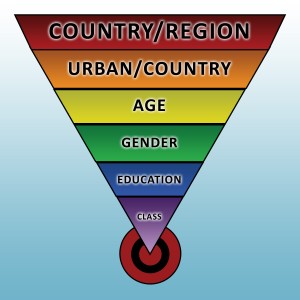 Step 1: Break down your audience by country and/or region.
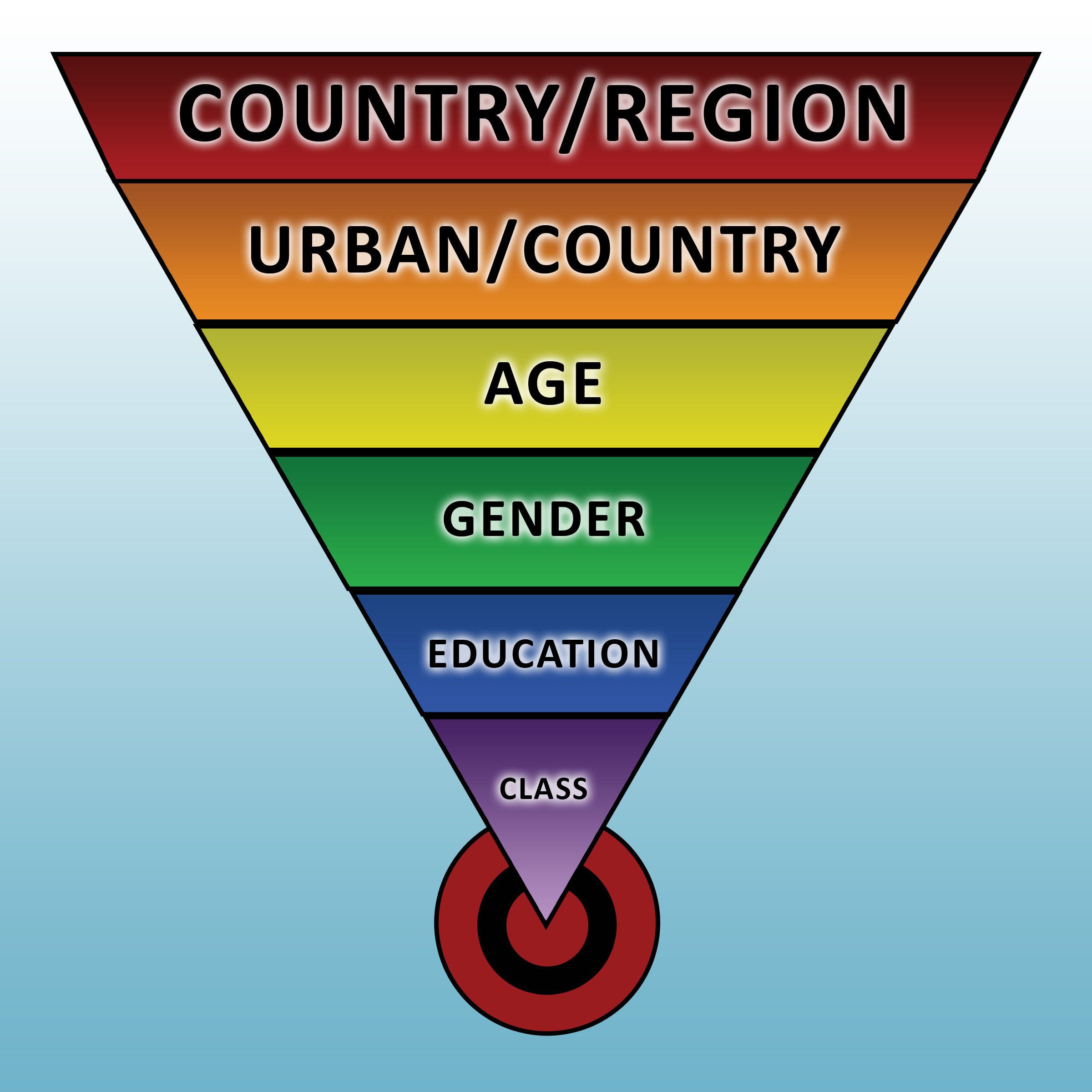
- Try to stick with one or two countries at most.
- Ask yourself if your subject matter is relevant to other cultures.
- Take into account language and currency barriers.
- If you’re targeting a large country, you may want to break it down by region or province as well.
Step 2: Decide if your book will appeal more to urbanites, suburbanites or country folk.
- Do you envision people reading your book at a sidewalk cafe in a bustling city, on the sidelines at a soccer game or under an apple tree in an orchard?
- Understand that folks in the cities, suburbs and countrysides can all be avid readers. They all have access to Amazon.com and local bookstores, but the pace of their life dictates different tastes and interests in reading materials.
Step 3: Pick an Age Group or Generation
- Everybody wants to write to the youth population, but people over 18 buy and read books, too.
- Research different major generational groups — the Baby Boomers, Generation X, Generation Y, etc. Find the right one (note: ONE) that fits your style and subject.
Step 4: Choose Your Side of the Gender Gap
- Understand that at least 75% of the time, you will be targeting females. Period.
- The few exceptions for targeting males: sports books, some crime/mystery thrillers, science fiction and occasional self-help books.
- If you are a female author, it is going to be especially hard for you to target men (Nora Roberts had to change her entire persona down to her name [J.D. Robb] to target men, so did J.K. Rowling).
Step 5: Segment Your Market by Level of Education
- Consider your writing style and lexicon and decide what level of education your average reader should possess.
- Keep in mind that the average person in the U.S. reads at about an 8th grade level.
- Subject matter can also be relevant or irrelevant to people of certain educational backgrounds.
- Educational information also segues into occupational information which segues into financial information, which is critical. A person’s discretionary income to spend on things like books is a vital piece of knowledge in setting your price point and choosing what marketing mediums to use.
Step 6: Wrap it up with class.
- If you determined in Step 5 that your target market is college educated, in this step you have to figure out if they were legacies at Princeton or night school honorees.
- Don’t stop at middle class and upper class, consider blue collar and white collar, professional and managerial, etc.
If you go through these six steps carefully, you should be able to carve down your target population from an impossibly large chunk to a very manageable bite. Like we said in the Five Commandments, it’s not exact science and sometimes it does take a few tries to pick the right path (think of it like a Choose-Your-Own-Adventure novel!), but this at least gives you a basic filtering system to get you pointed in the right direction.
You can also take it a step further, continuing to break down your target market by ethnicity, income, marital status, hobbies, and more. The more specifics you know about the people you’re reaching out to, the better!
Encore (Bonus tips!):
- For more on the components of a marketing plan, check out this awesome article from HowStuffWorks.com.
- I highly recommend this YouTube video about Greg Stielstra’s “PyroMarketing” technique explaining why mass marketing is dead.
- Remember our Five Tips for Constructing Characters? Think about using a character profile to identify details about your target reader.
- Use the information from the above steps to determine what your target market wants out of a book (i.e. a light summer read, a tale of great romance, a how-to guide, etc.)
- Last tip: Know your statistics! Use sites like the U.S. Census Bureau, Office for National Statistics and even Google to get an idea of how many people are in your target market.
I hope this helps everyone and as always, if you have questions, feel free to jump in the discussion below or you can send us an e-mail or find us on Twitter (@duolit).
 We're
We're 








Pingback: Friday Finds: Finding your target market & sites for kids & Teachers! « Writers Inspired()
Pingback: Can women write authentic male characters? | Lynley Stace()
Pingback: 10 steps to mastering your book marketing plan | 30 Day Books()
Pingback: Publetariat Dispatch: Are You Making These 7 Book Marketing Mistakes? | Author's Corner @ Kindle Nation Daily()